TL;DR
- 103 new internship postings a day (median); 63 % are removed by rules before any LLM call
- Median LLM cost of $0.15 a day; detection to Telegram notification in 3 min (p50)
- Runs unattended on a 1 vCPU / 2 GB VPS, 30 days of production data
Problem
AI internships appear first on company career pages (Greenhouse, Ashby, Workday…) and only later, often without a description, on job boards. Checking 119 companies by hand every day is not realistic, and most new postings are out of scope: wrong country, wrong field, past cycle, or a copy of a posting already seen.
intern-radar finds those postings as soon as they are published, triages them against a candidate profile, and sends only the good ones to Telegram with a one-tap tailored cover letter.
Architecture
flowchart LR
    subgraph collect [Every 2 h, 08:00 to 22:00]
        A[11 source adapters<br/>Greenhouse, Ashby, Workday,<br/>Lever, Adzuna…] --> B[Rules pre-filter<br/>title, location, field,<br/>cycle, duplicates]
        B -->|kept| C[LLM triage<br/>JSON schema,<br/>10 offers per call]
        C --> D[Deterministic score<br/>in Python]
    end
    B -->|removed| X[(SQLite)]
    D --> X
    D -->|high score| T[Telegram notification]
    D -->|medium| G[Evening digest]
    T -->|tap Lettre| L[Cover letter<br/>CV facts only,<br/>fidelity checks]
    L --> P[One-page PDF<br/>in the chat]
    X --> W[Private web app<br/>offers, applications, CVs]
- Collect: one adapter per job-board API, internship titles only, at least 1 s between two requests to the same host. A broken posting or source never stops the run, and a source failing for 3 days raises an alert.
- Pre-filter: pure rules remove what an LLM call would waste money on (France-only, out-of-scope fields, past cycles, aggregator copies).
- Triage: an LLM returns internship status, AI relevance, fit with the internship window, eligibility and visa notes, validated against a JSON schema.
- Score:
0.5 × company tier + 0.3 × AI relevance + 0.2 × dates, computed in Python with hard exclusions, so it is reproducible and tested. - Act: a notification with Voir l’offre and Lettre de motivation buttons; the letter is drafted from the CV only, checked for invented facts, and returned as a PDF.
Technical choices & trade-offs
- Rules before the LLM. Two thirds of the postings are rejected for free by regular expressions and location rules; the LLM only sees what rules cannot decide.
- The LLM judges, Python scores. The model returns structured facts (dates fit, eligibility, AI relevance), never
the final score. The weighting is a pure function with unit tests, so changing a weight is a
rescore, not a new round of prompts. - Company career APIs, not job boards. Greenhouse, Ashby or Workday publish postings first and in full; aggregators (Adzuna, Simplify) only fill the gaps, and their copies of an ATS posting are dropped.
- SQLite, systemd and the standard library. One file, one 1 vCPU / 2 GB VPS, no framework for the web app: the whole system fits a student budget and runs unattended.
- Telegram as the interface. No inbound port on the server (long polling), notifications on the phone, and the letter arrives where the offer was read.
Results
Production database, 2026-10-07 to 2026-11-05 (30 days):
| Metric | Value |
|---|---|
| New internship postings per day (median) | 103 |
| Removed by the rules before any LLM call | 63 % of 3,264 |
| LLM tokens per day (median, every purpose) | 113,956 |
| LLM cost per day (median, API-equivalent) | $0.15 |
| Run duration p50 / p95 | 69 s / 5 min |
| Detection to Telegram notification p50 | 3 min |
Coverage: 119 companies, 85 of them with a public feed read by one of the 11 adapters.
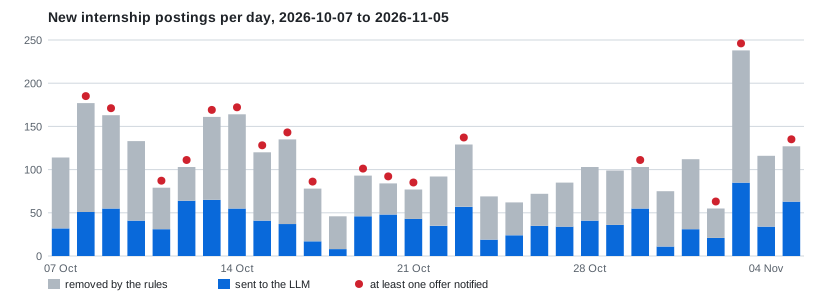
Generated by intern-radar metrics from the production database.
Limitations & next steps
- 34 watched companies (Google, Meta, Apple, Mistral…) publish no usable feed and are only seen through aggregators, with a delay and often without a description.
- The LLM triage is a filter, not a verdict: scoring the same offers twice does not always give the same categorical answers, and many postings do not state their dates. Its precision and recall have not been measured against hand labels.
- Single user, single Telegram chat; letters are generated one at a time.
- The triage uses the
claudeCLI and its subscription quota, shared with interactive use. - TODO: next steps you plan (for example a hand-labelled set to measure triage precision and recall).