TL;DR
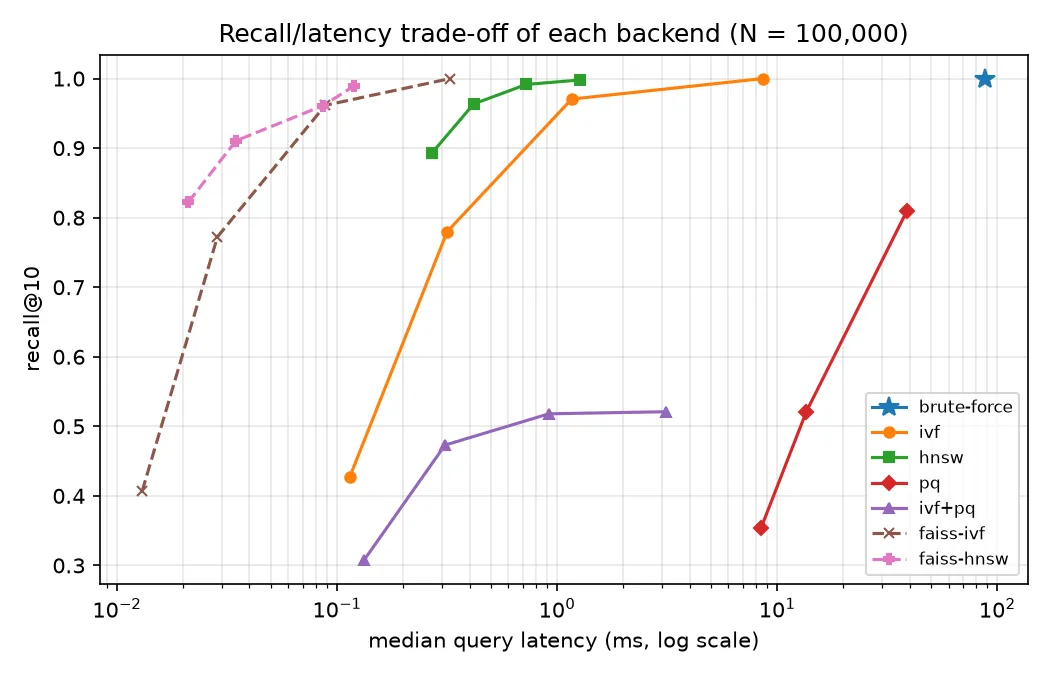
- Hand-written HNSW: recall@10 of 0.992 at 0.72 ms p50 on 100,000 SIFT1M vectors, against 88 ms for an exact scan
- 432× faster than brute force at 100,000 chunks, recall@10 0.929
- BEIR SciFact nDCG@10 from 0.668 to 0.706 with cross-encoder reranking
Problem
Answer questions over your own documents on a CPU, with no inference API and no data leaving the machine, and understand every trade-off of the retrieval layer instead of hiding it behind a framework. The vector indexes are written from scratch and measured against brute force and FAISS on public datasets.
Architecture
flowchart LR
    subgraph ingest [Ingestion]
        S[PDF, Markdown,<br/>web page] --> C[Chunker<br/>fixed or sentence]
        C --> D[Deduplication] --> E[Embedder<br/>all-MiniLM-L6-v2]
    end
    E --> V[(Vector store<br/>brute force, IVF,<br/>HNSW, PQ, IVF+PQ)]
    subgraph answer [Answering]
        Q[Question] --> RW[Query rewriting<br/>optional]
        RW --> R[Top-k search]
        R --> RR[Cross-encoder<br/>reranking, optional]
        RR --> F[Relevance filter]
        F --> P[Prompt fitted to<br/>the context window]
        P --> L[Local LLM<br/>llama.cpp, GGUF]
        L --> A[Answer + sources]
        L -. not enough context .-> R
    end
    V --> R
    API[FastAPI / CLI] --> S
    API --> Q
- Vector search from scratch: exact cosine scan, IVF with its own k-means, a multi-layer HNSW graph, product quantization and IVF+PQ, all in NumPy, with incremental updates.
- Retrieval pipeline: query rewriting, cross-encoder reranking, a relevance threshold that refuses to answer without supporting context, and an agentic loop that searches again when the first context is not enough.
- Local generation: llama.cpp with a GGUF model; the prompt is fitted to the model’s context window and the answer cites the chunks it was given.
- Service: FastAPI (
/ask,/ask/stream,/documents,/health) and a CLI sharing the same code.
Technical choices & trade-offs
- Indexes written by hand, measured against FAISS. The point is to understand and control every trade-off (recall, latency, memory, build time); FAISS is the yardstick, not a dependency.
- HNSW as the default approximate index. On both SIFT1M and the project’s own embeddings it reaches the recall of an exact scan at a fraction of its latency. IVF builds much faster and stays useful when the corpus changes often.
- A local LLM through llama.cpp. No API key, no data leaving the machine, CPU-friendly quantized weights.
- No LangChain. Chunking, prompt fitting, reranking and the agentic loop are short, tested modules; each step can be switched on or off and evaluated alone.
- Refuse rather than guess. Below a relevance threshold the agent says the documents do not cover the question, without calling the model; above it, the prompt tells the model to answer only from the passages.
Results
All figures come from scripts in benchmarks/, on one CPU thread.
Vector indexes on SIFT1M (100,000 base vectors, 200 public queries, recall@10 against the exact top 10):
| Method | Setting | Recall@10 | p50 latency | p95 latency | Memory | Build |
|---|---|---|---|---|---|---|
| Brute force (NumPy) | exact scan | 1.000 | 88.19 ms | 111.52 ms | 48.8 MB | 0 s |
| IVF (this project) | 316 lists, nprobe=16 |
0.971 | 1.17 ms | 5.13 ms | 49.9 MB | 21.6 s |
| HNSW (this project) | M=16, ef=32 |
0.963 | 0.42 ms | 0.49 ms | 70.1 MB | 300.7 s |
| HNSW (this project) | M=16, ef=64 |
0.992 | 0.72 ms | 0.85 ms | 70.1 MB | 300.7 s |
| PQ (this project) | 64 bytes per vector | 0.809 | 38.80 ms | 49.49 ms | 6.4 MB | 500.9 s |
| IVF+PQ (this project) | 32 bytes, nprobe=16 |
0.518 | 0.92 ms | 1.22 ms | 4.4 MB | 257.4 s |
FAISS IndexIVFFlat |
316 lists, nprobe=16 |
0.962 | 0.09 ms | 0.12 ms | 49.7 MB | 1.3 s |
FAISS IndexHNSWFlat |
M=16, ef=128 |
0.990 | 0.12 ms | 0.15 ms | 62.6 MB | 4.0 s |
At scale on the project’s own embeddings (384 dimensions, fastest setting reaching recall@10 ≥ 0.9):
| Chunks | Brute force p50 | HNSW p50 | HNSW recall@10 | Speed-up |
|---|---|---|---|---|
| 10,000 | 9.40 ms | 0.43 ms | 0.937 | 22× |
| 100,000 | 418.11 ms | 0.97 ms | 0.929 | 432× |
Retrieval quality on BEIR SciFact (5,183 scientific abstracts, 300 expert-labelled questions):
| Configuration | nDCG@10 | hit@10 | p50 latency |
|---|---|---|---|
| Chunks, exact search | 0.668 | 80.7 % | 39.9 ms |
Chunks, HNSW (ef=64) |
0.668 | 80.7 % | 12.1 ms |
| Chunks, exact search + cross-encoder on the top 20 | 0.706 | 82.0 % | 953.6 ms |
Retrieval on the project’s golden dataset (50 questions with hand-written reference passages, top 5, no LLM):
| Configuration | Evidence recall | MRR | Median latency |
|---|---|---|---|
| Exact search | 96.1 % | 0.833 | < 0.1 s |
| Exact search + cross-encoder | 96.9 % | 0.950 | 0.4 s |
Limitations & next steps
- Pure NumPy is 6 to 13 times slower per query than FAISS at the same recall, and HNSW construction is slow (5 minutes at 100,000 vectors, against 4 s for FAISS) because insertion runs in Python.
- Product quantization keeps memory low but loses too much recall on SIFT1M to be used alone.
- Answer faithfulness is not published yet: the evaluation harness (
rag-agent eval --judge) exists, but a local judge needs more than one CPU. - The relevance threshold alone refuses none of the 7 unanswerable questions of the golden dataset: they use the corpus vocabulary, so their passages score above it, and the refusal is left to the model.
- The store lives in process memory and on local disk: one node, no sharding, no concurrent writers.
- TODO: next steps you plan (for example publishing answer faithfulness with a stronger judge).